 2026.04.03
 Industry News
Content
The drainage electrofusion fittings series is a comprehensive range of polyethylene (PE) pipe connection components that use embedded electrical resistance wires to fuse pipes and fittings together through controlled heat. When an electrofusion controller passes current through the fitting's internal wire coil, the surrounding PE material melts and bonds seamlessly with the pipe surface — creating a joint that is as strong as the pipe itself. With a documented leakage rate of less than 1%, the system significantly outperforms traditional welding and mechanical joining methods for drainage applications across chemical, food, beverage, pharmaceutical, and civil infrastructure industries.
Understanding the working principle of electrofusion fittings clarifies why they deliver superior performance compared to conventional joining methods:
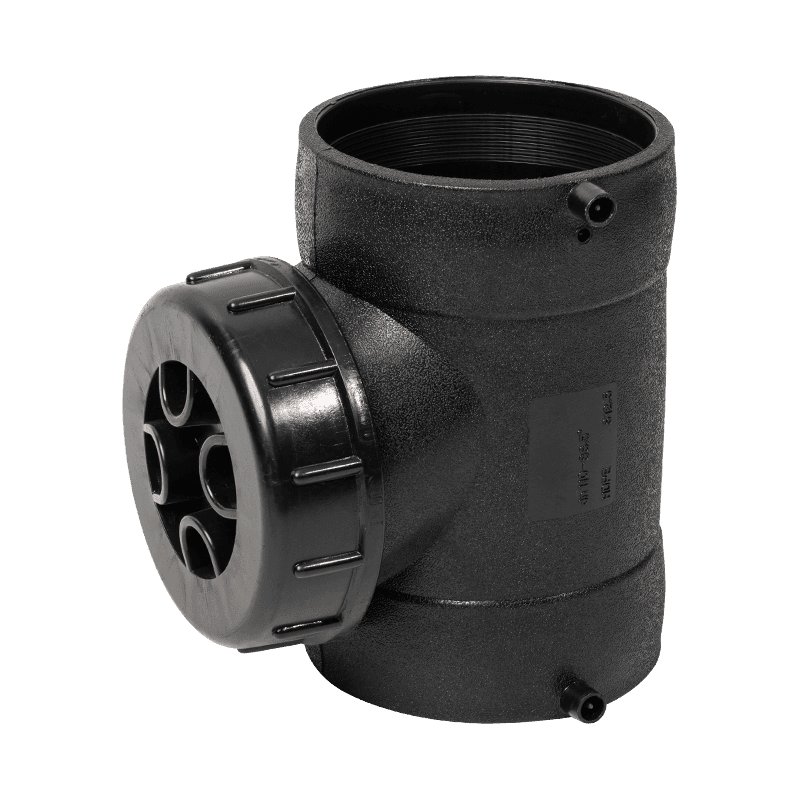
A complete drainage electrofusion series typically includes the following fitting types, each serving a specific function within the pipe system:
Used to create branch connections directly onto an existing main pipe without cutting it. The clamp saddle fuses onto the pipe surface and provides a sealed outlet for lateral connections — commonly used in repair work and network expansion.
The most fundamental fitting in the series — joins two pipe sections of equal diameter end-to-end. Available in standard and reducing configurations for connecting pipes of different sizes.
Creates a T-shaped branch in a pipeline. Available in equal and reducing configurations, allowing the main flow to continue while diverting a secondary flow at 90 degrees. Widely used in drainage manifolds and distribution networks.
Changes the direction of a pipeline. Available in 45° and 90° configurations. Electrofusion elbows maintain full bore flow area and eliminate the pressure drop and leak risk associated with threaded or push-fit bends.
Connects pipes of different diameters while maintaining a flat bottom line — essential in gravity drainage systems where maintaining a consistent invert level is critical to prevent standing water or blockage.
Provides access to the pipeline interior for inspection, cleaning, or minor repair. A sealed, tamper-evident access point that maintains the pressure integrity of the system while enabling maintenance without full pipe section replacement.
| Parameter | Typical Specification |
|---|---|
| Base material | PE80 / PE100 polyethylene |
| Diameter range | DN20 – DN630 mm |
| Operating pressure | Up to PN16 (1.6 MPa) |
| Fusion voltage | 8V – 48V DC (controller-dependent) |
| Leakage rate | <1% |
| Operating temperature range | -20°C to +60°C |
| Compliance standards | ISO 8085-3, EN 12201, GB/T 13663 |
Electrofusion fittings offer several measurable advantages over mechanical couplings and traditional butt-welding or socket fusion techniques:
The drainage electrofusion fittings series is used across a wide range of industries wherever sealed, reliable, and long-lasting pipe connections are required:
 General Manager Mr.Song +86-18868665013 / Miss Zhou +86-13757458992
 International Sales Manager: Jim Yao +86-18968349877
 +86-574-62939789
 Wechat/WhatsApp: +86-18968349877
 [email protected]; [email protected]
 No. 147 Dushan, Sanqi Town, Yuyao City, Zhejiang Province
Copyright © Ningbo Heqi Pipe Co., Ltd. All rights reserved. Wholesale Drainage Pipes Manufacturer Drainage Fittings Supplier



 EN
EN

 English
 中文简体
中文简体