 2026.02.13
 Industry News
Content
The core differences between PE hot melt pipe fittings and electrofusion fittings lie in the connection method, construction process, application scenarios, and cost structure. PE hot melt pipe fittings are mainly connected by heating and melting and then mechanically butting the joints, which are suitable for large-diameter pipelines and standardized construction; while electrofusion fittings rely on built-in heating wires that are energized to complete fusion welding, making them more suitable for space-limited environments, emergency repair projects, and high-precision installation scenarios. Both are important components of polyethylene pipeline systems, but each has its own advantages in engineering applications.
PE hot melt pipe fittings use a butt fusion welding machine: heat the end faces of pipes and fittings, bringing the PE material to a molten state, then mechanically butt them together and allow cooling to form an integrated connection structure. This method belongs to physical fusion connection, with high connection strength and good joint stability.
Electrofusion fittings have resistance wires pre-embedded inside: through a special electrofusion welding machine, electricity is applied to generate heat, causing the pipe and fitting to melt and fuse simultaneously, forming a sealed structure. This belongs to electrothermal fusion connection technology.
The core difference lies in: PE hot melt pipe fittings → external heating + mechanical butting、Electrofusion fittings → internal heating + automatic fusion
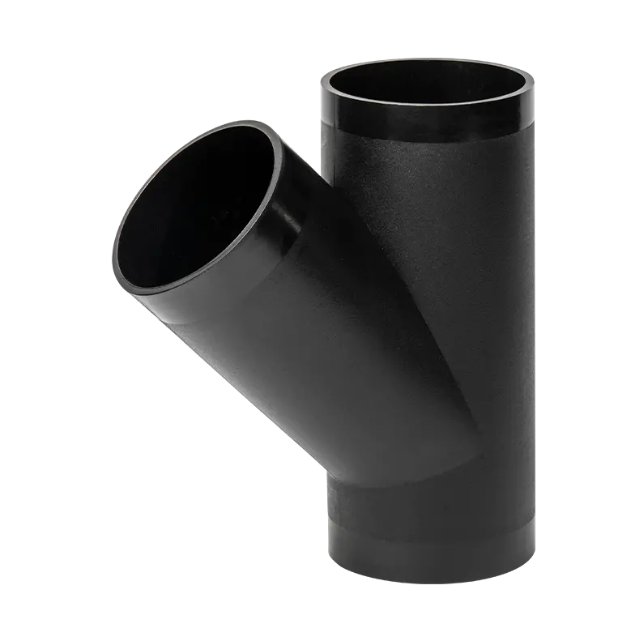
PE hot melt pipe fittings are more suitable for the following environments: municipal projects with sufficient construction space, new pipeline network construction projects, large-diameter pipeline systems, engineering sites with regular pipeline layouts.
Electrofusion fittings are suitable for complex working conditions: pipeline renovation and maintenance projects, underground pipeline emergency repairs, operations in narrow spaces, pipeline misalignment repair scenarios.
Therefore, in actual projects: PE hot melt pipe fittings are often used in main pipeline system construction, while electrofusion fittings are more commonly used in branch connections and maintenance scenarios.
From the perspective of structural safety: PE hot melt pipe fittings: integrated fusion structure at the joint, high tensile strength, strong pressure-bearing capacity, service life can reach more than 50 years (under municipal standard conditions).
Electrofusion fittings: precise fusion, stable sealing performance, good joint consistency, excellent anti-leakage performance. In high-pressure transmission systems, such as gas pipelines and main water supply networks, PE hot melt pipe fittings have greater structural advantages; while in scenarios requiring high precision connection and sealing, electrofusion fittings have greater stability advantages.
| Comparison Dimension | PE hot melt pipe fittings | Electrofusion Fittings |
| Equipment requirement | Butt fusion welding machine | Electrofusion welding machine |
| Operation difficulty | Medium | Relatively low |
| Alignment requirement | High | Relatively loose |
| Labor dependence | Strong | Relatively low |
| Automation level | Low | High |
PE butt fusion fitting construction relies more on technical experience: with high requirements for alignment accuracy, temperature control, and pressure control; while electrofusion fittings have a higher level of intelligence, with automatic temperature and time control and a high degree of standardized operation, making them more suitable for standardized construction teams.
From the perspective of overall cost: PE hot melt pipe fittings: low unit cost, high one-time equipment investment, suitable for large-scale project batch construction, lower unit length cost.
Electrofusion fittings: high unit price, high construction efficiency, low maintenance cost, more suitable for small-scale projects and emergency projects.
Therefore, in municipal engineering: PE hot melt pipe fittings have greater large-scale cost advantages; in maintenance projects, electrofusion systems have greater flexibility advantages.
Typical applications of PE hot melt pipe fittings: municipal water supply networks, urban gas main pipelines, agricultural irrigation systems, industrial transmission pipelines, water supply and drainage projects.
Typical applications of electrofusion fittings: underground pipeline maintenance, urban gas branch lines, old pipeline network renovation, construction in narrow spaces, pipeline misalignment repair projects.
Engineering Selection Principles: Large-scale new construction projects → prioritize PE hot melt pipe fittings, High-strength transmission systems → PE hot melt pipe fittings are better, Renovation and maintenance projects → prioritize electrofusion fittings, Space-limited scenarios → electrofusion fittings are more suitable, Cost-sensitive projects → PE hot melt pipe fittings have higher cost performance.
With the development of pipeline engineering technology: PE hot melt pipe fittings and electrofusion fittings have formed a complementary application system. PE hot melt pipe fittings have obvious advantages in structural strength, large-scale construction, and cost control, while electrofusion fittings perform better in precision construction, complex environment adaptability, and maintenance projects. Scientific selection not only relates to construction efficiency, but also directly affects the safety and service life of pipeline network systems.
Recommended Products
 General Manager Mr.Song +86-18868665013 / Miss Zhou +86-13757458992
 International Sales Manager: Jim Yao +86-18968349877
 +86-574-62939789
 Wechat/WhatsApp: +86-18968349877
 [email protected]; [email protected]
 No. 147 Dushan, Sanqi Town, Yuyao City, Zhejiang Province
Copyright © Ningbo Heqi Pipe Co., Ltd. All rights reserved. Wholesale Drainage Pipes Manufacturer Drainage Fittings Supplier



 EN
EN

 English
 中文简体
中文简体