 2025.10.13
 Industry News
Content
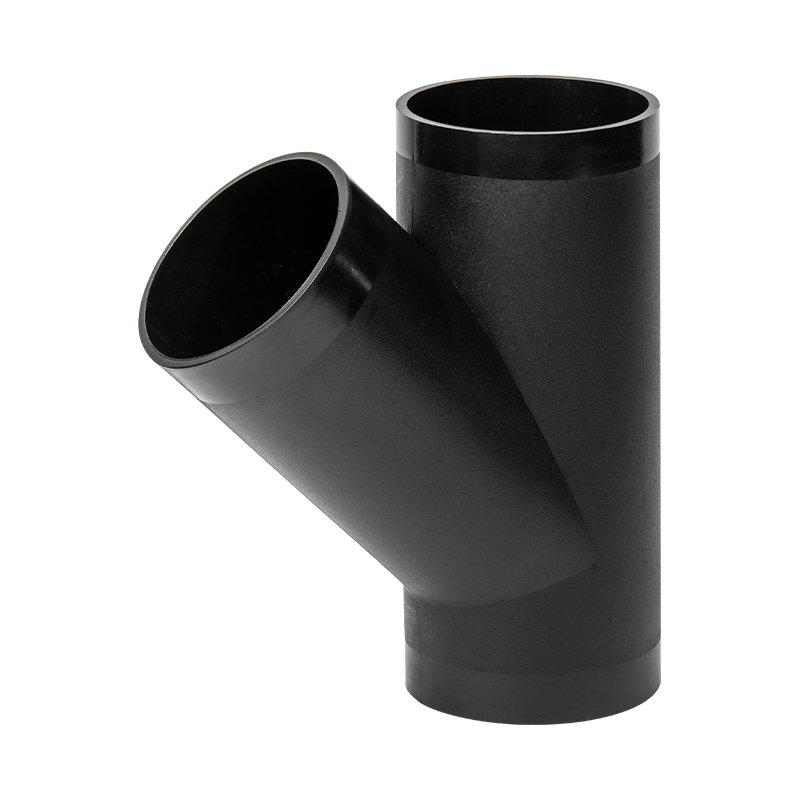
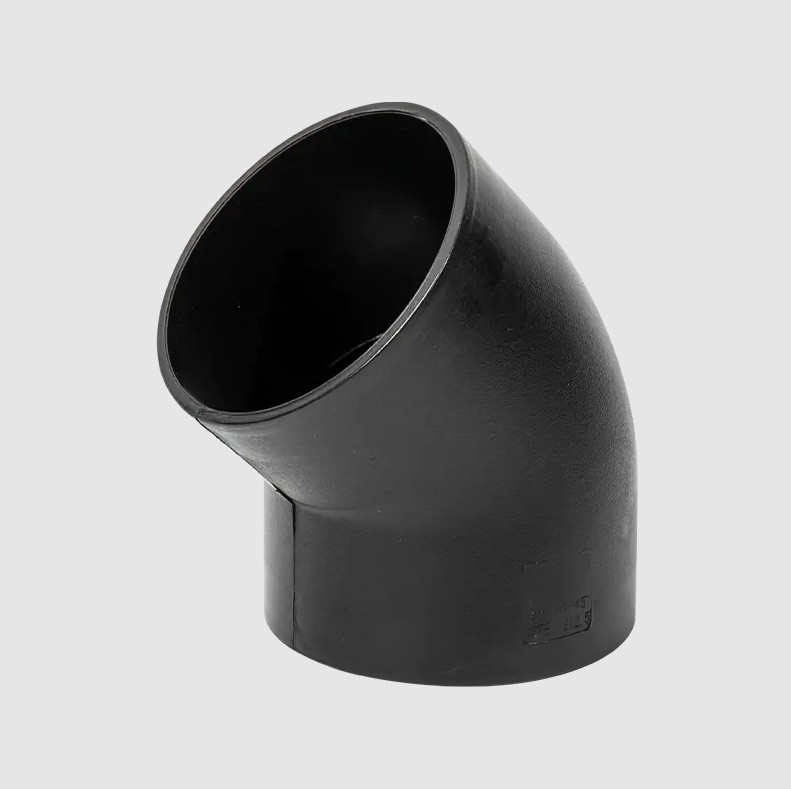
A PE Pipe Fittings 45° Elbow is a specialized pipe connector made of high-density polyethylene (HDPE) or medium-density polyethylene (MDPE) used to achieve a 45-degree angle in a piping system. It is a critical component of polyethylene (PE) piping systems, designed to minimize energy loss and hydraulic shock when fluids change direction.
The exceptional properties of PE give 45° elbows the following key advantages: strong corrosion resistance, excellent resistance to low-temperature frost cracking, lightweight and high strength, and excellent impact resistance. These properties ensure that PE Pipe Fittings 45° Elbows maintain long-term, stable performance even when buried underground, in hot and humid environments, or conveying harsh chemical media, making them an ideal alternative to traditional metal elbows.
The production of PE Pipe Fittings 45° Elbow generally adheres to international and domestic standards, such as ISO 4427 and GB/T 13663, to ensure that their dimensional accuracy and pressure ratings meet design requirements.
Main connection methods include:
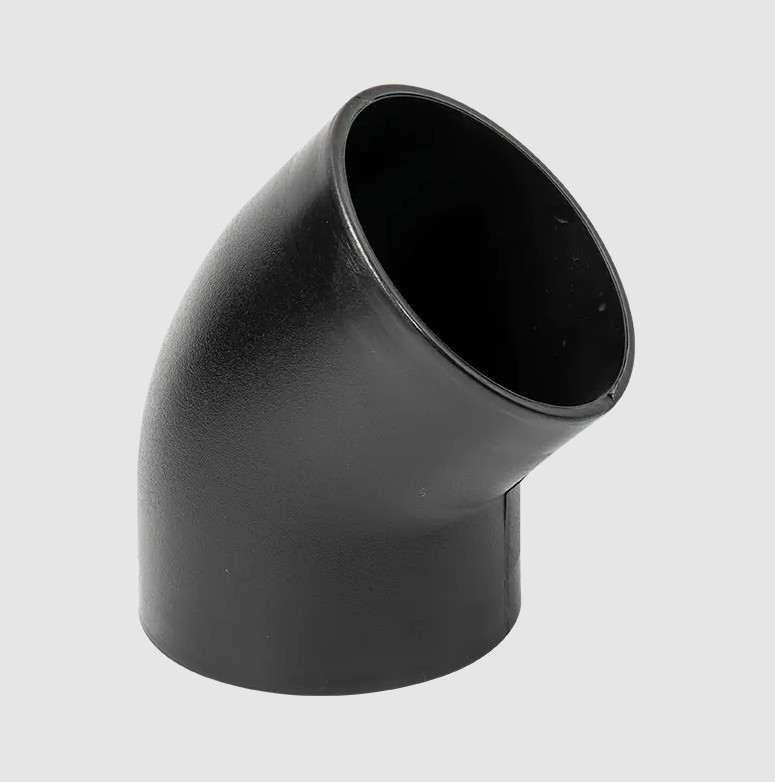
The use of PE Pipe Fittings 45° Elbow in piping systems reflects the comprehensive consideration of efficiency, safety, and economy in modern engineering design.
The 45-degree bend design is its greatest technical highlight. In the field of fluid control, the flatter the bend, the lower the local resistance coefficient (K value) generated during fluid flow. Compared to sharp 90-degree elbows, PE 45-degree elbows can:
The polyethylene material ensures the long-term reliability of the elbow. Its inherent wear resistance makes it wear much slower than metal pipes when conveying media containing solid particles (such as slurry and sediment). Furthermore, the inherent chemical inertness of PE means that PE Pipe Fittings 45° Elbow are immune to electrochemical corrosion, even in acidic and alkaline environments. This results in:
| Comparison Dimensions | PE Pipe 45° Elbow (Gentle Bend) | PE pipe fittings with 90° elbows (sharp bends) |
| Main Functions | Fine-tune steering, optimize flow, and avoid obstacles. | Sharp turns (right angles), connections in confined spaces |
| Hydraulic Loss | Extremely low flow. Smoother flow lines make it the preferred choice for applications that prioritize fluid control. | Higher pressure. Prone to strong vortexes and impacts, resulting in significant head loss. |
| Installation Scenario | Suitable for long-distance pipelines, pipeline systems with high flow and energy requirements, and for achieving tiered 90° bends (replacing two 45° elbows). | Suitable for short-distance pipe networks, branch lines, equipment interfaces, and other areas with tight space requirements. |
| Economic Considerations | The initial investment is slightly higher, but long-term energy and maintenance costs are extremely low, making it highly cost-effective. | The initial investment is low, but long-term energy consumption and maintenance costs are relatively high. |
When designing professional piping systems, the choice between 45° and 90° elbows depends on the priority of flow control. When the design goal is to minimize hydraulic losses and optimize system energy efficiency, engineers will prefer to use two PE Pipe Fittings 45° Elbow with a short pipe to achieve a 90° turn. Although this slightly increases the material and installation workload, the long-term benefits are significant.
The answer is: 45° elbows in PE pipe do generate local resistance, but this resistance is minimal among all turning elements and far less than the impact of 90° elbows on flow.
According to the classic Darcy-Weisbach equation or the equivalent length method, the total head loss in a pipeline is composed of longitudinal loss (straight pipe friction) and local loss (pipe resistance).
The function of a 45° elbow: Its gentle turn effectively reduces the local loss coefficient. This means that at the same system pressure and flow rate, a piping system using a 45° elbow can maintain a higher effective flow rate.
Flow rate assurance: Rather than "reducing flow," it's more accurate to say that it maximizes flow rate. In long-distance water or precision chemical transportation, it's this meticulous flow assurance that makes 45° elbows in PE pipes a critical connector for optimizing system performance.
PE Pipe Fittings 45° Elbow, with their superior performance and reliable sealing, are widely used in industries requiring the highest levels of reliability and efficiency:
The 45° PE pipe elbow is a core connector for efficient, reliable, and long-term operation in modern piping systems. It is not only a physical component for diverting pipes, but also a key element in engineering design that balances flow control, energy optimization, and cost-effectiveness.
The installation quality of a 45° PE pipe elbow directly determines the operational safety and sealing of the entire piping system. Proper connection is critical to preventing future leaks and failures. The most commonly used professional connection techniques are heat fusion (including butt and socket) and electric fusion.
Butt fusion is one of the most secure methods for connecting PE pipes and elbows. It fuses the fitting and pipe into one piece, providing excellent sealing.
Electrofusion uses pre-embedded heating wires within the fittings to melt the contact surface between the elbow and the pipe, creating a reliable connection. It offers ease of operation and high reliability.
Although PE Pipe Fittings 45° Elbow offer excellent durability and corrosion resistance, improper operation or environmental factors can still cause some common failures during installation and long-term use.
| Common Failure Symptoms | Analysis of the main causes | Preventative and Remedial Measures |
| Leakage at the Joint | Butt fusion: Insufficient heating time or pressure leads to incomplete fusion; incomplete milling or large misalignment of the end faces results in localized cold welds. Electric fusion: Incomplete scraping, resulting in a surface oxide layer that hinders fusion; Insufficient cooling time leads to stress cracking. | Strictly follow installation specifications, especially regarding scraping and cooling times; use properly calibrated welding equipment to ensure tight connections. |
| Poor Solder or Brittle Fracture | Butt fusion: The heating plate temperature is too high or too low; stress is applied immediately after welding, causing movement during the cooling period. This deteriorates the properties of the polyethylene material. | Precisely control temperature and pressure; ensure adequate holding and cooling times to avoid operating the system before it is fully cured. |
| Excessive Flanging/Joint Shrinkage | Butt fusion: Excessive pressure causes excessive extrusion of molten material, compromising joint strength. | Set the correct welding pressure based on the pipe's SDR rating. |
| Common Failure Symptoms | Analysis of the Main Causes | Preventative and Remedial Measures |
| Stress Cracking/Slow Cracking | Fitting quality issues: Use of recycled or low-quality polyethylene. Environmental impacts: Long-term exposure to high residual stress or external impact at low temperatures. | Select high-quality PE pipe fittings with 45° elbows that meet national standards; avoid subjecting the elbows to unnecessary external shear stress during installation. |
| External Damage | After underground installation, elbows may be crushed or punctured by external construction or sharp rocks. | Properly protect the backfill layer during pipeline laying, using fine sand or soft soil to prevent sharp objects from coming into direct contact with the pipeline system. |
| Chemical Corrosion (Rare) | Long-term exposure to strong oxidizing chemicals not specified in the design may cause slow structural damage to the polyethylene (extremely rare, unless the medium temperature is extremely high). | Strictly verify the chemical compatibility of the conveying medium to ensure that the corrosion resistance of the PE pipe fittings with 45° elbows meets the required standards. |
By understanding these common failures, users will not only better understand the limitations of PE Pipe Fittings 45° Elbow but also take more proactive preventative measures during installation and maintenance, ensuring the long-term stable operation and fluid control efficiency of the piping system.
 General Manager Mr.Song +86-18868665013 / Miss Zhou +86-13757458992
 International Sales Manager: Jim Yao +86-18968349877
 +86-574-62939789
 Wechat/WhatsApp: +86-18968349877
 [email protected]; [email protected]
 No. 147 Dushan, Sanqi Town, Yuyao City, Zhejiang Province
Copyright © Ningbo Heqi Pipe Co., Ltd. All rights reserved. Wholesale Drainage Pipes Manufacturer Drainage Fittings Supplier



 EN
EN

 English
 中文简体
中文简体