 2025.10.13
 Industry News
Content
When connecting two pipes of different diameters, reducing fittings become essential. However, traditional concentric designs have inherent drawbacks when handling certain fluids and operating conditions. For this reason, PE eccentric reducers, with their unique structural design and superior performance, have become the professional choice for solving complex fluid problems.
A PE eccentric reducer is a specialized fitting used to achieve a smooth transition between pipe diameters. Made of durable polyethylene (PE), it offers excellent corrosion resistance, high strength, lightweight construction, and excellent chemical resistance, making it widely used in various fields, including water conservancy, gas, and chemical engineering.
Unlike conventional concentric reducers, the centerlines of the two ends of a PE eccentric reducer—the larger and smaller diameters—do not coincide, but are offset. Structurally, it exhibits an asymmetrical tapered transition, with one edge remaining straight while the other edge tapers. It is this unique eccentric design that gives it a key advantage in fluid control.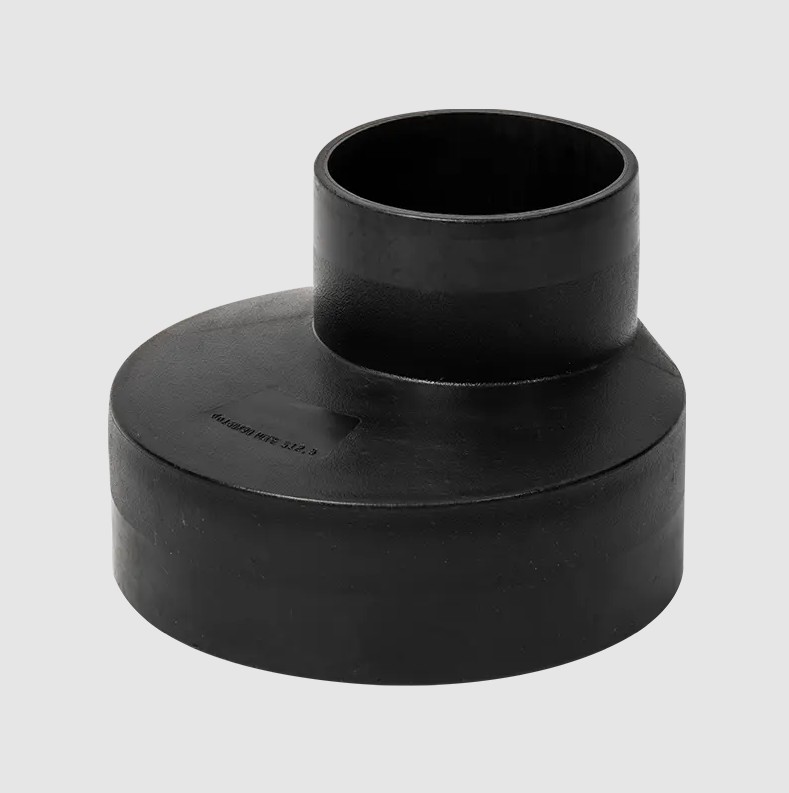
The operating principle of the PE eccentric reducer is based on fluid dynamics optimization to eliminate two major engineering challenges that can arise at diameter changes in horizontal pipelines: cavitation and solids settling.
In horizontal pipelines, traditional concentric reducers result in structural discontinuities in the fluid path at the top or bottom:
Due to their unique flow optimization capabilities, PE eccentric reducers are primarily used in the following critical applications with special requirements for the fluid environment:
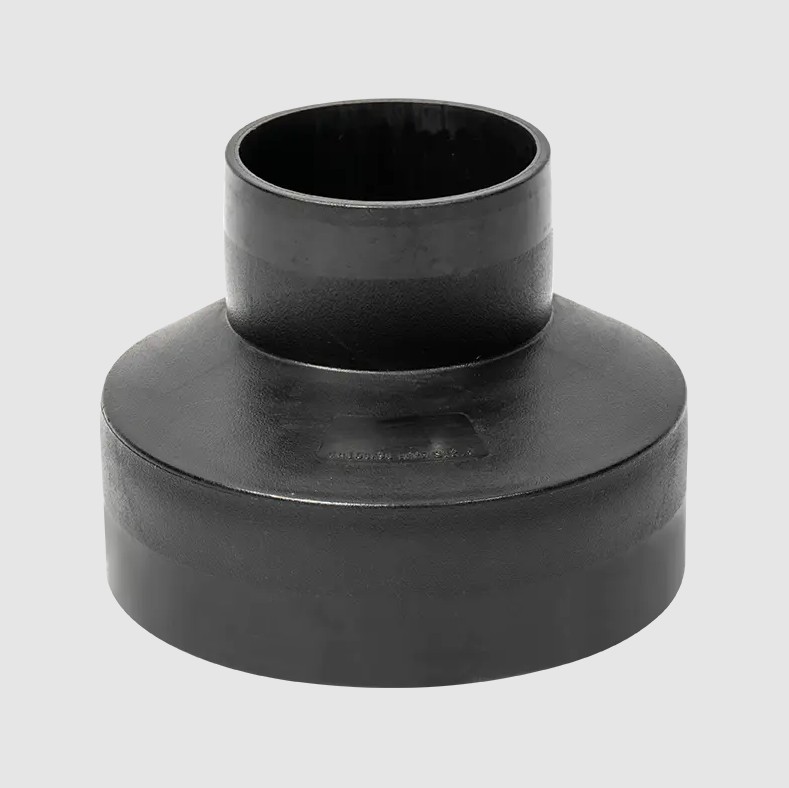
Although both concentric reducers and PE eccentric reducers are used to reduce pipe diameters, they differ fundamentally in structure and function:
| Feature Comparison | Concentric Reducer | PE Eccentric Reducer |
| Centerline | The centerlines of the two pipe ends coincide (coaxial). | The centerlines of the two pipe ends are offset (non-coaxial). |
| Shape | A symmetrical frustum shape. | It features an asymmetrical taper with one side flat. |
| Installation Advantages | Used for vertical pipe installation or short-distance pipe reduction. | It can be installed in horizontal pipes to eliminate sedimentation and cavitation issues. |
| Fluid Effects | Can easily form air pockets at the top (horizontal) or sedimentation areas at the bottom (horizontal). | The flush design optimizes fluid distribution and reduces flow resistance. |
| Applicable Fluids | Used for clean gases or clean liquids. | It is suitable for liquids containing solid particles, slurries, or those prone to gas generation. |
Choosing PE eccentric reducers isn't just about meeting design specifications; it's also a long-term investment in the entire piping system. The benefits include:
The selection decision should strictly follow the fluid characteristics and the pipe installation orientation:
In short, for any horizontal pipe change involving fluid cleanliness, pump protection, and pipe draining, the PE eccentric reducer is the uncompromising standard.
| Selection Scenarios | Recommended Pipe Fittings | Reasons |
| Horizontal piping for conveying particulate matter or wastewater. | PE Eccentric Reducer (Flat Bottom Installation) | Maintains a level bottom, preventing sedimentation and clogging. |
| Horizontal piping for connection to the pump suction port. | PE Eccentric Reducer (Flat Top Installation) | Eliminates air pockets, prevents cavitation, and protects the pump. |
| Vertical piping (either upward or downward flow). | Concentric Reducer | In vertical piping, gravity evenly distributes the fluid, and concentric fittings are sufficient. |
| Horizontal piping for conveying clean, sediment-free, and gas-free fluids. | Concentric Reducer | Reduced cost and simple construction, they can be used in applications where there's no risk of cavitation or sedimentation. |
During on-site installation, ensuring the correct orientation of PE eccentric reducers is crucial for preventing design failures. This isn't typically a matter of calculating the geometric centerline, but rather a matter of functional positioning:
Positioning principle: Function determines flushness.
Proper installation ensures the fitting can fully perform its flow-optimizing function, maximizing the reliability and durability of the entire PE piping system.
As a key component in a piping system, the performance benefits of PE eccentric reducers (eliminating air pockets and preventing sedimentation) require reliable, durable connections to fully realize their benefits. Polyethylene (PE) pipe connection technology is at the core of modern pipeline engineering, and the quality of the connection directly impacts the sealing, pressure-bearing capacity, and service life of the entire system.
Hot-Melt Butt Fusion is the most commonly used and economical connection technology for PE pipes, particularly suitable for large-diameter PE eccentric reducers. This connection method heats and pressurizes the pipe fittings and pipe ends, causing them to melt and re-fuse, forming a single, integral joint with properties consistent with the parent material.
Electrofusion uses a heating wire embedded within an electrofusion fitting (such as an eccentric reducer) to generate heat, melting the contact surface between the fitting and the pipe. Cooling creates a tight connection.
Flange connection is the standard method for connecting PE eccentric reducers to metal pipes, valves, pumps, or other non-PE equipment. This connection uses a pair of flanges, a gasket, and a set of bolts to create a mechanical seal.
 General Manager Mr.Song +86-18868665013 / Miss Zhou +86-13757458992
 International Sales Manager: Jim Yao +86-18968349877
 +86-574-62939789
 Wechat/WhatsApp: +86-18968349877
 [email protected]; [email protected]
 No. 147 Dushan, Sanqi Town, Yuyao City, Zhejiang Province
Copyright © Ningbo Heqi Pipe Co., Ltd. All rights reserved. Wholesale Drainage Pipes Manufacturer Drainage Fittings Supplier



 EN
EN

 English
 中文简体
中文简体