 2026.01.23
 Industry News
Content
High-quality HDPE siphon pipes have a service life of over 50 years under standard conditions. Regarding concerns about outdoor embrittlement, HDPE siphon pipes from reputable manufacturers contain 2% to 2.5% of a special carbon black UV-resistant additive in the raw materials. This gives the pipes excellent weather resistance. Even when exposed to sunlight outdoors for extended periods, they effectively resist molecular chain breakage caused by ultraviolet radiation, preventing embrittlement and aging.
HDPE siphon pipes use high-density polyethylene as the raw material, a material known for its "stability" in the chemical industry.
Chemical stability: It resists corrosion from most acids, bases, and industrial chemicals, meaning the drainage system remains stable even in industrial areas with severe acid rain.
Flexibility and impact resistance: HDPE has excellent toughness, with an elongation at break typically exceeding 350%. The pipes are less likely to fracture in extreme situations such as building settlement or earthquakes.
Low-temperature resistance: Its embrittlement temperature is below -70°C, so it won't crack easily during winter construction and use in cold regions, unlike PVC pipes.
Many plastic products turn white and become brittle after prolonged exposure to sunlight, but professional HDPE siphon pipes have multiple defense mechanisms:
Manufacturers uniformly disperse ultra-fine carbon black in the polyethylene matrix during the production of HDPE siphon pipes. Carbon black absorbs light energy and converts it into heat, acting as a "sunshade" to block ultraviolet radiation from penetrating deep into the pipe material.
High-quality pipes contain efficient antioxidants. By testing the oxidation induction period (OIT), it can be ensured that the internal physical structure of the pipe does not undergo oxidative degradation during its service life of up to half a century.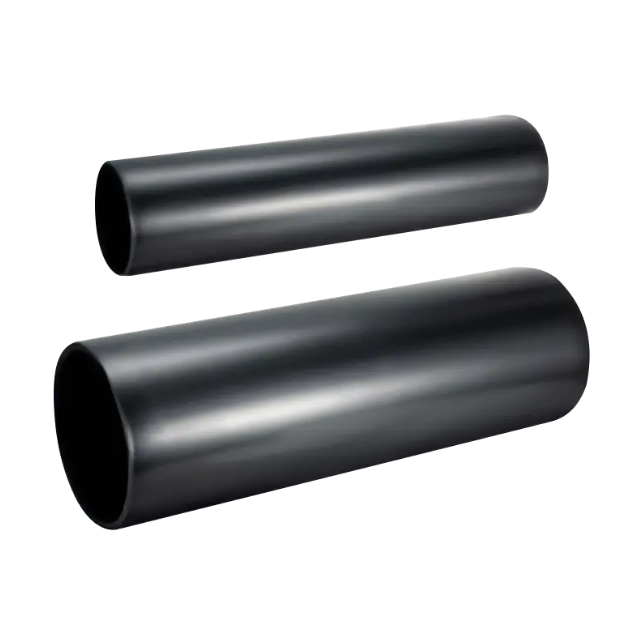
Although the material itself is long-lasting, actual use is also affected by the following factors:
Connection process: The siphon system generates significant negative pressure during operation. Only by using hot-melt butt welding or electrofusion connection, ensuring "homogeneous fusion" between the interface and the pipe material, can the entire HDPE siphon pipe system be guaranteed to be leak-free for 50 years.
Wall thickness rating (SDR): Selecting the appropriate wall thickness rating (such as SDR11 or SDR17 series) based on the system pressure is crucial to preventing premature pipe damage due to pressure fatigue.
Installation specifications: The supporting secondary suspension system must be stable to absorb the internal stress generated by thermal expansion and contraction of the HDPE pipes.
As a professional HDPE siphon pipe manufacturer, we recommend distinguishing between products based on the following three points:
Appearance: High-quality pipes have a dark, glossy surface with uniform color.
Certification: Check if the product has passed the 5000-hour artificial weathering test conducted by the National Chemical Building Materials Testing Center.
Cross-section: Cut the pipe and observe the cross-section to see if it is fine, without bubbles or impurities.
With its excellent chemical resistance, UV resistance, and ultra-long lifespan of up to 50 years, HDPE siphon pipes have become the preferred choice for modern large-scale building roof drainage. As long as you choose a reputable brand and strictly follow the construction specifications, there is no need to worry about outdoor embrittlement.
Recommended Products
 General Manager Mr.Song +86-18868665013 / Miss Zhou +86-13757458992
 International Sales Manager: Jim Yao +86-18968349877
 +86-574-62939789
 Wechat/WhatsApp: +86-18968349877
 [email protected]; [email protected]
 No. 147 Dushan, Sanqi Town, Yuyao City, Zhejiang Province
Copyright © Ningbo Heqi Pipe Co., Ltd. All rights reserved. Wholesale Drainage Pipes Manufacturer Drainage Fittings Supplier



 EN
EN

 English
 中文简体
中文简体